




The Short Answer: To prepare for a long-term power outage, make a written household plan, store water and non-perishable food, keep medication and emergency supplies on hand, and set up backup power for essential loads. Start with medical equipment, refrigeration, lighting, communication, and your water supply, then add battery storage and solar panels to keep those priorities running for days.
A long-term power outage can follow severe weather, winter storms, high winds, a natural disaster, or damage to the electrical grid. If the utility company cannot restore the power grid quickly, your household may lose electrical power, water, refrigeration, communication, and access to local services.
Planning for a Long-Term Power Outage
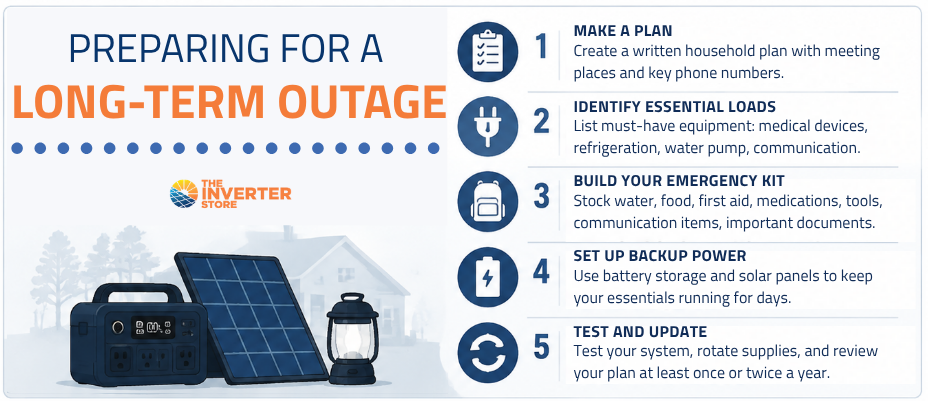
Start with a written household plan. List every family member, including children, older adults, pets, and anyone who depends on a medical device. Choose an out-of-area contact, decide where everyone will meet if you cannot stay home, and keep important phone numbers on paper instead of only in electronic devices.
Make the plan with every family member involved. Assign simple responsibilities, such as checking emergency supplies, charging electronic devices, caring for pets, or contacting relatives. Practice the plan before severe weather events arrive.
List the equipment your household must keep running during an extended outage:
- Medical equipment and refrigerated medication
- A refrigerator, full freezer, well pump, sump pump, or furnace blower
- Cell phone charging, lights, a radio, and essential electronics
- A router or other communication equipment
Then identify the loads you can leave off. An electric stove, clothes dryer, central air conditioning, and electric heat use far more power than lights, a cell phone, or a medical device. This list helps you size a backup system around your basic needs.
Build Your Emergency Kit
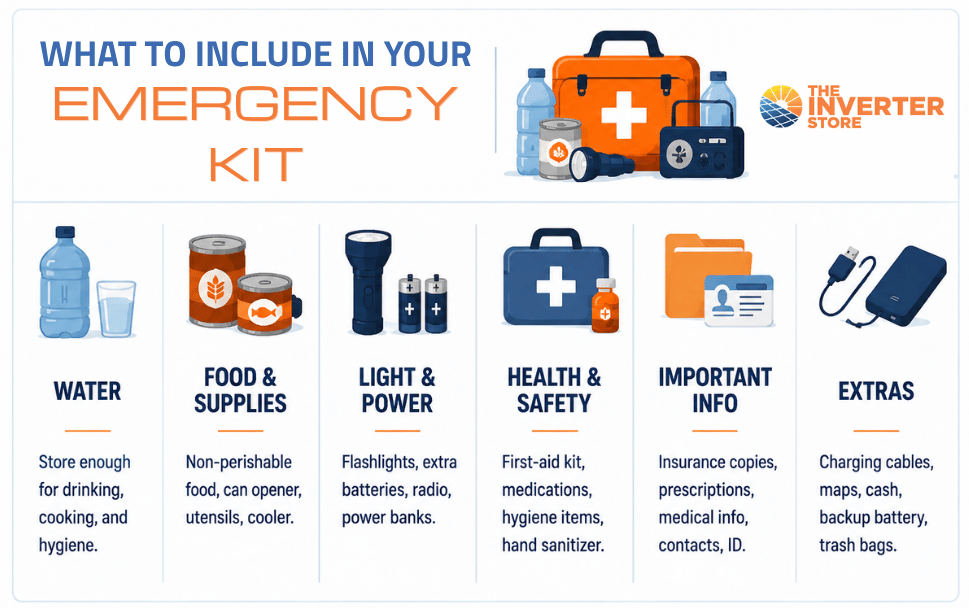
Keep an emergency preparedness kit in an easy-to-reach location. It should cover food, water, sanitation, communication, and first aid without relying on the electrical grid.
Include:
- Water for drinking, cooking, hygiene, pets, and medication needs
- Non-perishable food, a manual can opener, utensils, and a cooler
- Flashlights, a battery-powered or hand-crank radio, and extra battery packs
- A first-aid kit, prescription medication, hygiene products, trash bags, and hand sanitizer
- Copies of insurance, prescriptions, medical information, and emergency contacts
- Charging cables, a backup battery, local maps, and modest emergency cash
Store enough water for drinking, cooking, hygiene, pets, and medication needs, along with non-perishable food your household can prepare without refrigeration or an electric stove.
Store Food and Water
If your home depends on an electric well pump, store extra water before an extended power outage. Your water supply may fail when the electrical infrastructure that runs the pump loses power.
Plan meals around food that does not require refrigeration or an electric stove. Keep a full pantry, rotate it regularly, and use coolers with ice for priority items if needed.
Keep refrigerator and freezer doors closed during a power outage. A refrigerator typically keeps food cold for about four hours, while a full freezer can hold temperature for about 48 hours if the door stays closed.
Plan for Medical Devices and Medication
A family member who relies on a medical device needs a dedicated plan. This can include a CPAP, oxygen concentrator, powered wheelchair, feeding pump, or other medical equipment. List the device, its wattage, daily runtime, charging method, and extra battery requirements.
Talk with the medical provider or equipment manufacturer before an outage. Ask how long the device can run from battery power, whether it needs pure sine wave power, and what backup options are appropriate. Also keep a written emergency plan for every medical device, including its power requirements, backup runtime, charging method, provider contact information, and the steps your household will take in case you need to relocate.
A pure sine wave inverter paired with LiFePO4 lithium batteries can provide stable AC power for selected medical equipment when sized correctly. Keep an extra battery for each critical device when possible, and consider a portable power station for lower-draw equipment or temporary use.
Build Backup Power That Lasts
A battery system gives you stored electrical power. A solar panel system gives you a way to replace that energy during the day. Together, they provide a better long-term option than relying only on a charged battery.
Start With an Extra Battery
Start with the equipment you cannot do without. An extra battery can support a cell phone, lighting, a router, medical device, refrigerator, or other essential load when paired with the right inverter.
Battery capacity determines how long a load can run. Inverter capacity determines what you can run at one time. A 100-watt router and a few phone chargers need much less electrical power than an electric stove or space heater.
An inverter charger can charge a battery bank and convert battery power into household AC power. Pair it with a pure sine wave inverter or an inverter charger that matches your essential-load needs. Use inverter and battery cables sized for your system voltage, inverter wattage, and cable length.
For a simpler starting point, battery backup kits combine compatible components for essential backup power. Add more than one extra battery when your runtime calculations require it.
Add Solar Panels for Daily Charging
A solar panel lets you recharge batteries during daylight, reducing reliance on gas stations, fuel, and a working power grid. This is especially useful during a long-term power outage.
Solar output changes with shade, weather, season, and panel angle. Size each solar panel array around your daily energy use, then leave room for cloudy weather and charging losses. A solar generator can support lower-draw essentials such as lights, phones, communication devices, and some medical equipment.
For larger needs, an off-grid solar kit combines the core solar components needed for a battery-backed system. A portable solar kit may be a better fit when you need a more temporary setup and portable panels.
Plan for Safety and Communication
During a widespread outage, gas stations, ATMs, stores, cell towers, and internet service may be limited. Keep your cell phone charged, but also keep a battery-powered radio, printed contacts, local maps, and enough fuel in your vehicle before severe weather arrives.
Check updates from your utility company and stay away from every downed power line. Never touch one, drive over one, or attempt to move one.
If you own a portable generator, use it only outdoors and at least 20 feet from doors, windows, and vents. Install a carbon monoxide detector on every level of the home and near sleeping areas. Improper generator use can cause carbon monoxide poisoning, which can be fatal.
Test Your Setup
Emergency preparedness works best when you test it before you need it. Once or twice a year, run essential loads from your backup system, check every solar panel, charge controller, inverter, battery cable, and extra battery, test your carbon monoxide detector, rotate food and medication, and update the needs of each family member.
Not sure what fits your home? Contact The Inverter Store or call 888-417-8673 to talk to a real customer support team.
Frequently Asked Questions
How long will a battery backup system last during a power outage?
It depends on your battery capacity and what you’re running. A properly sized inverter charger paired with a lithium or lead acid deep cycle battery bank can run a refrigerator, lights, and medical equipment for hours or days. Lithium delivers more usable capacity per charge, but either chemistry works for backup. Adding solar panels extends runtime by recharging during the day.
Can solar panels work during a power outage?
Yes. A solar panel can recharge batteries during a power outage when connected to a properly designed battery-based system. Standard grid-tied solar alone typically shuts down during an outage.
How many extra batteries do I need?
Add up the watts your essential loads use, estimate how many hours you need them to run, and account for inverter losses. Your final extra battery capacity should cover that energy use with a reserve for poor weather or increased demand.
How do I prepare a medical device for an extended outage?
Confirm the device’s power needs with the manufacturer or medical provider. Keep an extra battery, charging method, replacement supplies, and a relocation plan ready before the extended outage begins.

Leave A Comment