



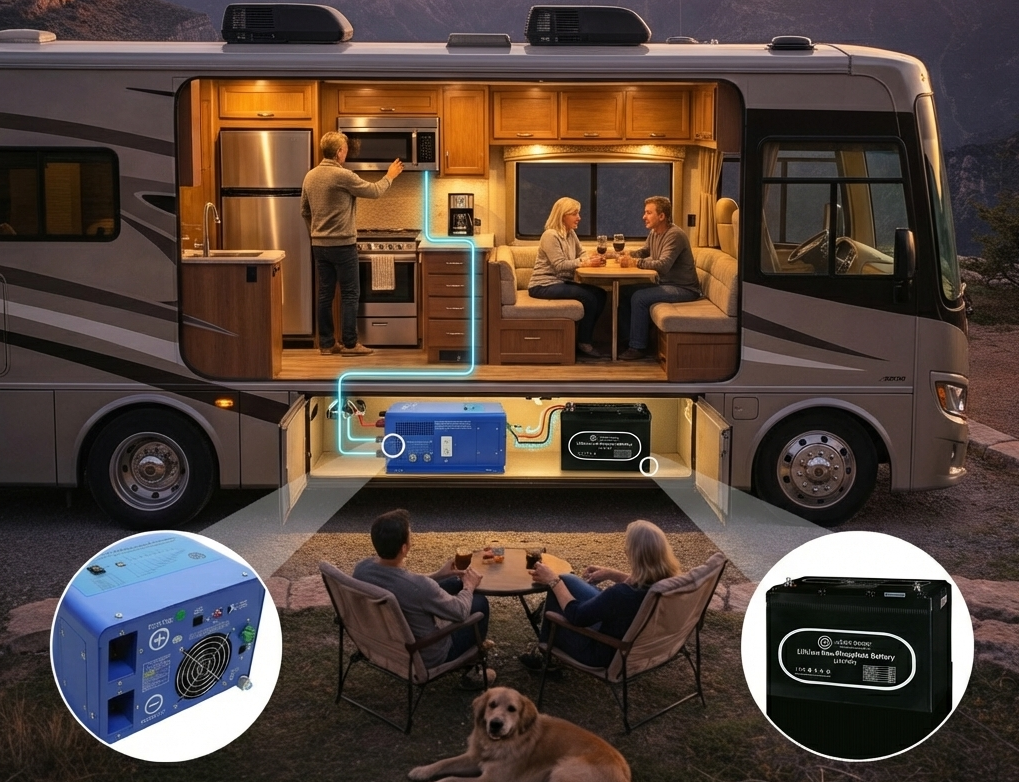
The Short Answer: A power inverter changes one type of electricity into another. Batteries produce power that flows in a single direction (direct current, or DC). Your appliances, electronics, and tools need power that alternates back and forth (alternating current, or AC), which is the same stable electricity that comes from a wall outlet. An inverter makes that conversion so you can run everyday devices from a battery.
The Problem an Inverter Solves
Most people don’t think about the mechanics behind their power until something stops working. The lights go out during a storm, or they’re parked at a campsite staring at a battery with no way to plug in a coffee maker. That’s where a power inverter comes in.
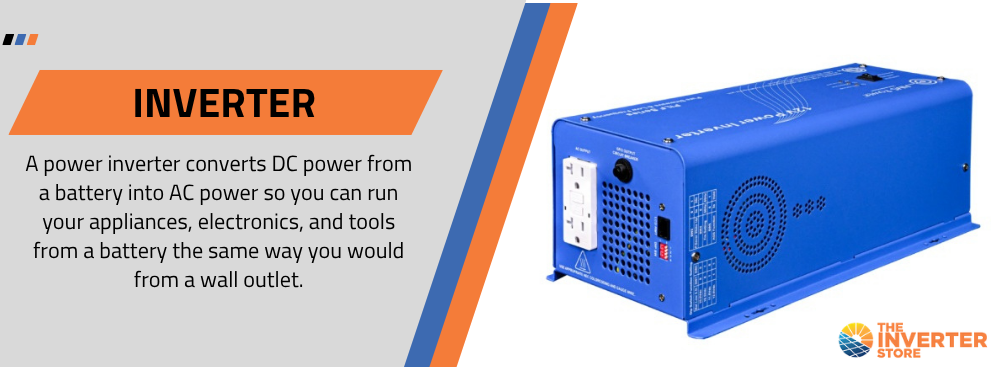
Solar panels and batteries produce DC power, but most household appliances, electronics, and medical equipment are built to run on AC power. These two types of electricity are not interchangeable. An inverter system sits between the battery and your devices, converting the DC power into usable AC power so you can plug in and run all your devices.
Where Inverters Get Used
An inverter shows up anywhere someone needs to run AC devices from a battery. Some of the most common setups include:
- RVs and vans: Running a microwave, air conditioner, TV, or CPAP machine while parked off the grid or dry camping without hookups.
- Commercial trucks: Powering laptops, tools, and small appliances from the truck’s battery during downtime without idling the engine.
- Food trucks and mobile businesses: Running equipment quietly at venues where generators are restricted or impractical.
- Off-grid cabins and tiny homes: Providing full-time AC power from a solar and battery setup with no utility connection.
- Backup power: Keeping the house running during a power outage without a generator.
How a Power Inverter Converts DC to AC
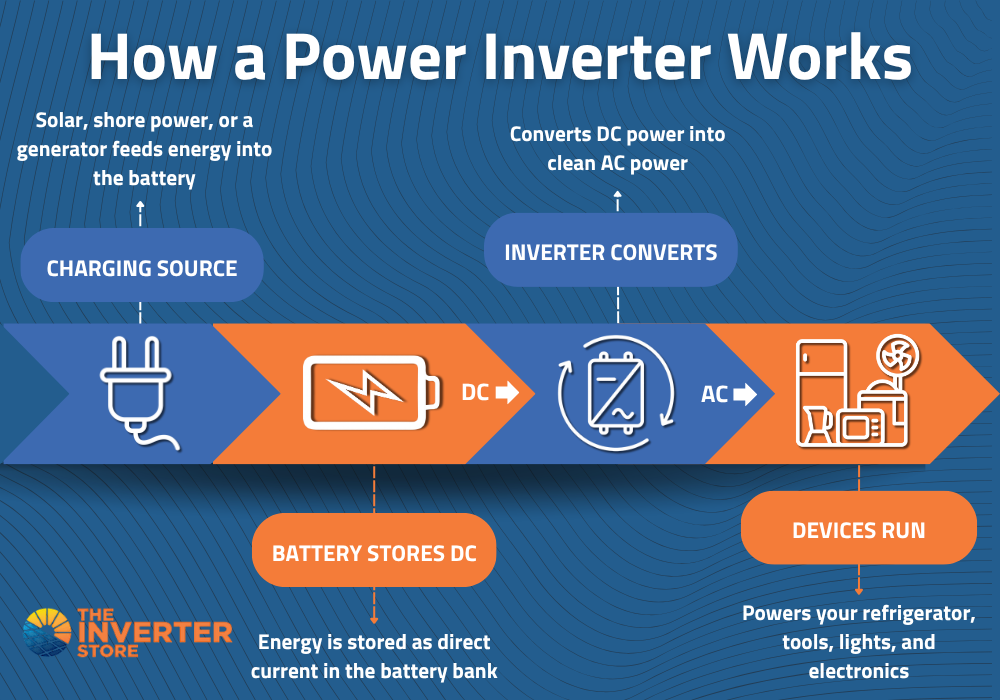
Direct current flows in one direction, like water through a hose. Alternating current switches direction back and forth 60 times per second in the United States. That alternating pattern is how the electrical grid delivers power to every outlet in your home, and it’s what your devices are built to receive.
Inverter technology converts electrical energy from DC to AC using electronic switches that rapidly flip the direct current back and forth. This process is called pulse width modulation. Pulse width modulation controls the switches as they turn on and off thousands of times per second, varying the width of each pulse so that the average output voltage follows the shape of a sine wave.
Filters on the output side smooth the pulses into a clean AC signal. The result is an output voltage that matches what your devices need: 120V in the US or 220/240V for international setups.
Why the Sine Wave Shape Matters
The quality of an inverter’s AC output is determined by how closely its sine wave matches the electrical grid’s production. This is measured by total harmonic distortion (THD). A pure sine wave inverter produces a smooth, clean waveform with THD below 3%, comparable to grid power. At that level, it safely runs electronics, medical equipment, inverter air conditioners, and any other device you’d plug into a wall outlet.
A modified sine wave is a stepped approximation of a true sine wave, with THD around 25%. It works for simple resistive loads like lights and fans but can cause buzzing, overheating, or a shortened lifespan in devices with motors or variable speed compressors. The type of sine wave an inverter produces is the single biggest factor in what you can use it for and safely plug into it.
Types of Inverters and When to Use Each
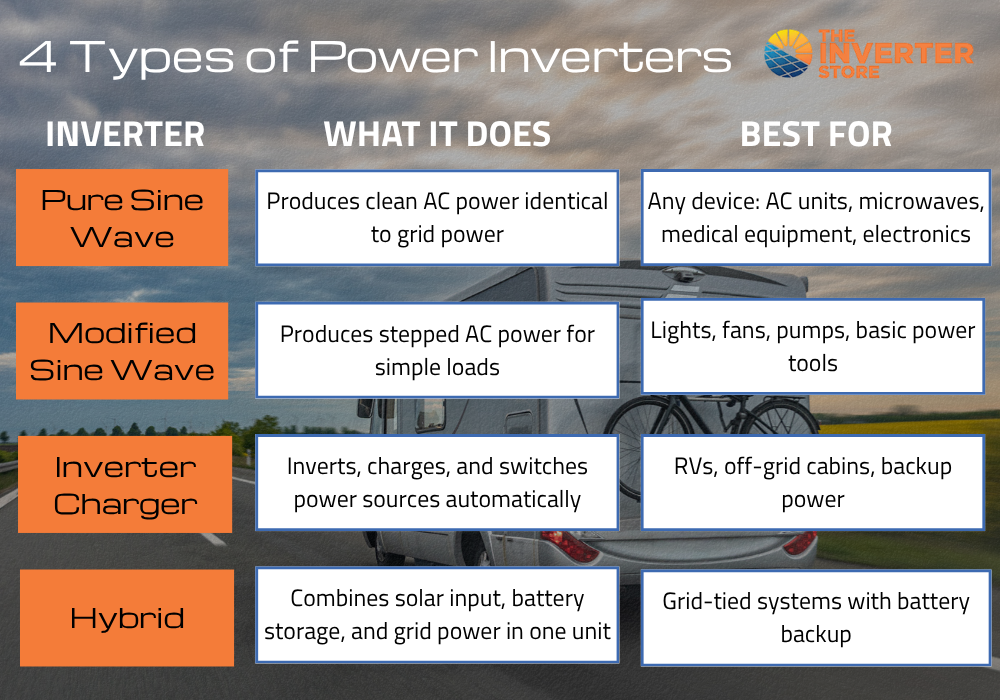
Not every inverter does the same job. Some only convert power, while others charge your batteries, switch between power sources, or tie into a solar panel array.
Pure Sine Wave Inverter
A pure sine wave inverter produces clean AC power identical to the electrical grid. It runs anything you would plug into a wall outlet. If you want to run the same devices you run at home, pure sine is the way to go.
Modified Sine Wave Inverter
A modified sine wave inverter handles straightforward setups where the loads are simple and predictable. Lights, fans, pumps, and basic power tools all run fine on modified sine, but for variable speed devices or electronic devices with digital displays, step up to pure sine.
Inverter Charger
An inverter charger provides AC power from your battery, charges your battery bank, and automatically switches between shore power, a generator, and battery power. When an outside source is connected, it passes that power through and charges the batteries. When it disconnects, the inverter kicks in with no manual switching required. This also improves energy efficiency by only drawing power when you need it.
Hybrid Inverter
A hybrid inverter works with solar panel input, battery storage, and the electrical grid in one unit. When your panels produce more than you’re using, it pushes the extra back to the grid, and when the grid goes down, it switches to battery backup.
How to Choose the Right Inverter for Your Setup
Every inverter setup starts with the same question: what are you trying to run, and how much power does it take?
Size for Your Load and Surge
Add up the running wattage of every electronic device you plan to power at the same time. For example, your refrigerator runs at 200 watts, your microwave pulls 1,200 watts, and your laptop charger draws 45 watts. That’s 1,445 watts at once, so you need an inverter rated for at least 1,500 watts of continuous power output.
Keep in mind that anything with a compressor or motor, like an air conditioner or inverter microwave, can surge 2 to 5 times its running wattage at startup. Your inverter’s surge rating needs to cover that spike, or it will trip and shut down. You can find wattage ratings on the label or nameplate of most devices.
Match Your Voltage and Wave Type
The input voltage has to match your battery bank. Inverters come in 12V, 24V, and 48V configurations, and larger systems tend to use 24V or 48V because higher voltage means lower current and smaller cables.
Decide if You Need Charging and Auto Transfer
If your setup connects to shore power or a portable generator at any point, an inverter charger saves you from buying a separate charger and transfer switch. For solar panel systems, pair your inverter with a charge controller or a hybrid inverter that has built-in solar input.
Pair With the Right Battery
A lithium battery delivers more usable capacity, weighs less, and lasts longer than lead-acid batteries. If you are building a new inverter system, pairing it with a lithium battery pays for itself over time through longer cycle life and deeper safe discharge.
Find the Right Inverter
The right inverter depends on what you’re running, how much power it pulls, and how your system is set up. If you know what you need, browse the full lineup of AIMS power inverters at The Inverter Store. If you’re not sure yet, our power calculator can help you figure out your wattage, or call our experts and talk to a real person who can walk you through the whole process.
Frequently Asked Questions
Can I run a refrigerator on a power inverter?
Yes. A typical refrigerator runs on 100 to 400 watts but surges at 2 to 5 times that on startup. Use a pure sine wave inverter and make sure its surge rating covers the startup spike.
What is the main difference between a pure sine wave inverter and a modified sine wave inverter?
A pure sine wave inverter produces clean AC power identical to what the electrical grid delivers. A modified sine wave inverter produces a rougher, stepped waveform. Pure sine runs all devices safely, while modified sine works for simple loads like lights, fans, and pumps but can damage sensitive electronics or shorten the life of motors with variable speed compressors.
Do I need an inverter or an inverter charger?
If your system connects to shore power, a portable generator, or any other AC source, an inverter charger is the better choice. It charges your battery bank and switches between power sources automatically, while a standalone inverter only converts DC to AC.
Can a power inverter replace a generator during a power outage?
Yes. A properly sized inverter paired with a lithium battery bank can run household appliances for hours or days with no fuel, no noise, and no carbon monoxide risk. Adding solar panels lets you recharge during the day for extended outages.
What size inverter do I need?
Add up the running wattage of everything you plan to power at the same time, then check the surge rating against your highest startup load. The Inverter Store’s power calculator does the math for you. If you are not sure, call 888-417-8673, and one of our technicians can walk you through it.

Leave A Comment