



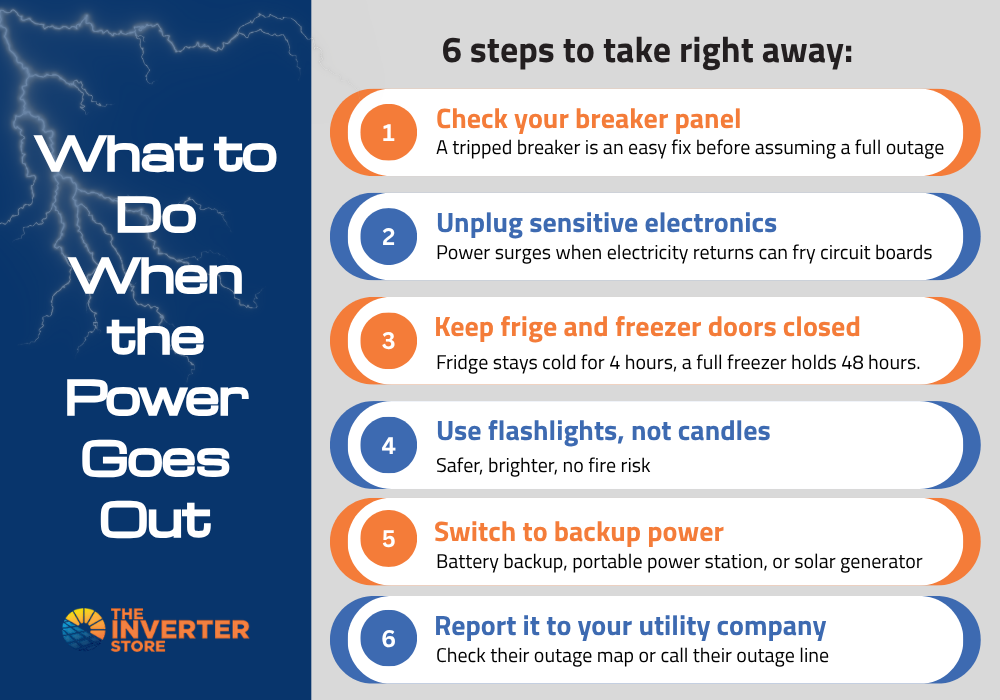
The Short Answer: Keep your refrigerator and freezer doors closed, unplug sensitive electronics, and use flashlights instead of candles. If you have a battery backup system or portable power station, switch to it. If you don’t, now is the time to plan for the next one. The best protection against a power outage is being ready before it happens.
Why Storms Cause Outages
The grid isn’t as tough as most people think. High winds from a severe storm knock trees into power lines. Ice from a winter storm builds on them until they snap. When extreme heat pushes everyone’s air conditioning at once, the electrical system can’t keep up and overloads.
Once a power line goes down or a substation circuit breaker trips, every home and business on that section of the grid goes dark. Your utility company will send crews out, but depending on how bad the outage is, repairs can take anywhere from a few hours to several days.
What to Have Ready When the Power Goes Out
Keep Your Food Safe
Your refrigerator keeps perishable food safe for about 4 hours without power as long as the door stays closed. Full freezers hold temperature for roughly 48 hours, and half-full ones for about 24, but only if the freezer door stays shut. After 4 hours with no power and no backup, throw out meat, poultry, fish, and eggs. A battery backup kit keeps it running the whole time so the clock never starts.
Emergency Lighting and Communication
Skip the candles. Flashlights and extra batteries are safer and simpler. Charge a portable charger before the storm so your phone stays alive for updates and contact with local officials. If you want one device that handles lighting, phone charging, and a radio or router all at once, a portable power station will cover it all with one solution.
Medical Devices and Equipment
Anyone who relies on a medical device like a CPAP, oxygen concentrator, or powered wheelchair needs backup power that kicks in immediately. A pure sine wave inverter paired with a lithium battery runs medical equipment on clean AC power the same way a wall outlet would. Always sort out your medical needs before storm season starts, not in the middle of an outage.
Keeping Cool or Warm
Losing air conditioning when temperatures climb isn’t just uncomfortable. For older adults and young children, it can become a safety issue fast. On the other end, a cold weather outage during a winter storm means your home starts losing heat the moment the system shuts down. An inverter charger sized for your air conditioning unit or space heater keeps things manageable until the grid comes back.
Protect Your Electrical Equipment Before and After the Outage
Unplug Before the Storm
Here’s what most people don’t think about: the outage itself usually isn’t what damages your stuff. The power surge that hits when electricity comes back on is. That sudden spike in voltage can fry circuit boards, kill control panels, and destroy digital displays in seconds.
If severe weather is heading your way, use surge protectors and unplug electrical equipment, electrical appliances, and medical devices before the lights even flicker. An inverter charger with an auto transfer switch sidesteps this entirely by switching your home to battery power before the surge ever reaches your outlets.
What to Check When Power Comes Back
Just because your power hasn’t automatically turned back on doesn’t mean that the outage is still going on. Look at your circuit breaker panel for a tripped breaker. If one has flipped, reset it and see if your electric service comes back.
Smell something off near the outlets? Hear buzzing from nowhere? Feel warm spots on the wall? Stay away from the electrical system and call your utility provider. And give it a few minutes before you turn major appliances back on so the voltage has time to stabilize.
What to Avoid During a Power Outage
Never Run a Generator Indoors
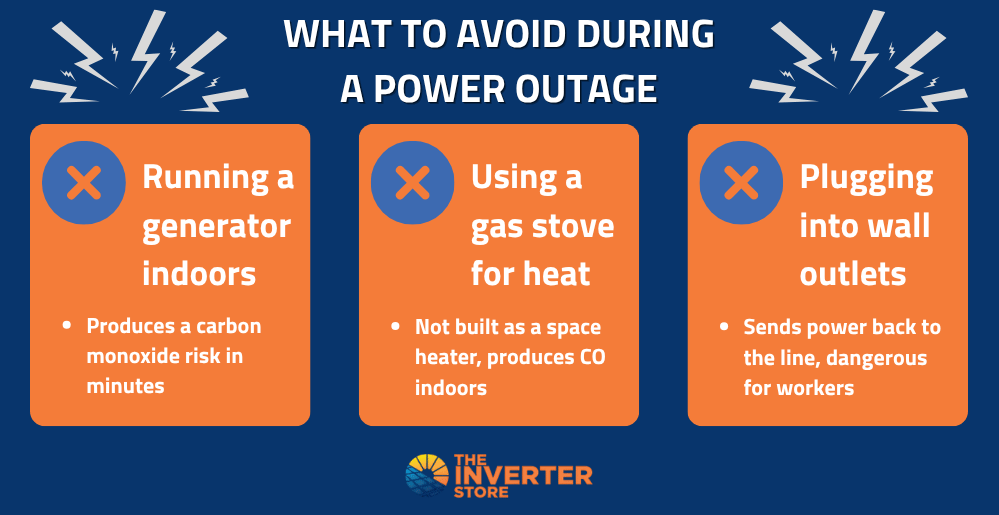
Running a generator indoors is very dangerous. Backup generators or any gas powered portable generator emit carbon monoxide, which, in an enclosed space, can cause carbon monoxide poisoning within minutes. That means never running one inside the house, garage, or near open windows. If you need power indoors, a battery based setup like an inverter charger and lithium battery bank puts out zero emissions and runs silently.
Don’t Heat Your Home With a Gas Stove or Charcoal Grill
A gas stove cooks food. It’s not a space heater, and running one for warmth in a closed room builds up carbon monoxide fast. Charcoal grills are a similar story. Both need to stay outdoors. If you lose heat during a cold weather outage, running a space heater through a properly sized inverter system is the far safer move.
Don’t Feed Power Back Through Your Wiring
Plugging a generator or inverter into a wall outlet with an extension cord to push power back into your home’s wiring is one of the most dangerous things you can do during an outage.
That electricity travels back through the wiring, out through the meter, and onto the power line, where utility workers think the line is dead, which puts the workers at risk. Always follow the manufacturer’s instructions and use a proper transfer switch for any permanent installation.
How to Keep the Power On Without the Grid
Size Your Backup to Your Loads
The right backup system depends on what you need to keep running. Add up the wattage of your refrigerator, medical equipment, lights, and anything else you can’t go without, then match that to the right inverter and battery combination.
Battery Backup Systems
The simplest way to keep your home running during an outage is an inverter charger paired with a lithium battery bank. It watches the grid, and the moment power drops, it switches to battery automatically. When the grid comes back, it switches again. No startup, no fuel, no carbon monoxide.
How long it runs depends on your battery capacity. A properly sized system will handle your refrigerator, lights, medical equipment, and air conditioning for hours or days at a time. Our backup power kits bundle the inverter charger, batteries, and cables so you’re not piecing it together yourself.
Portable Power Stations
Renting an apartment, or just don’t want a permanent install? A portable power station works right out of the box. Charge it from a wall outlet ahead of the storm and grab it when the power drops.
It won’t run a whole house, but it handles phone charging, emergency lighting, medical devices, and small electrical appliances. For a short to mid length outage, that covers the basics.
Solar Recharging for Extended Outages
Batteries run out eventually. When an extended power outage stretches past a day or two, solar panels and a charge controller let you recharge your battery bank during the day and keep running at night.
At that point, your system is fully independent of the grid, fuel stations, and your utility company. An off-grid solar kit bundles panels, an inverter, a charge controller, and a battery in one package so you don’t have to source each piece separately.
Build Your Outage Plan Now
Storm season comes every year, and so do outages. Figure out what you need to keep running, size your system to those loads, and have it ready before the next severe weather warning hits your area.
Browse backup power kits, portable power stations, and off-grid solar kits at The Inverter Store. Not sure where to start? Use the power calculator or call 888-417-8673 and talk to someone who is ready to help.
Frequently Asked Questions
How long does food last in the refrigerator during a power outage?
About 4 hours if you keep the door closed. After that, throw out meat, fish, eggs, and leftovers.
How long does a freezer stay cold without power?
Roughly 48 hours if it’s full, 24 hours if it’s half full. The key is keeping the freezer door closed the entire time.
Can I use a gas stove to heat my house during an outage?
No. Gas stoves aren’t built for space heating, and they produce carbon monoxide in enclosed areas. Run a space heater through an inverter instead.
What should I unplug during a power outage?
Anything with a circuit board, digital display, or sensitive electronics. The power surge when electricity comes back on is what does the damage. A surge protector helps for anything you leave plugged in.
What is the best backup power option for a power outage?
It depends on your setup. An inverter charger paired with a lithium battery bank handles the most loads and switches automatically when the grid drops. A portable power station is the easiest option if you rent or don’t want a permanent install. For extended outages, adding solar panels lets you recharge without the grid.

Leave A Comment