



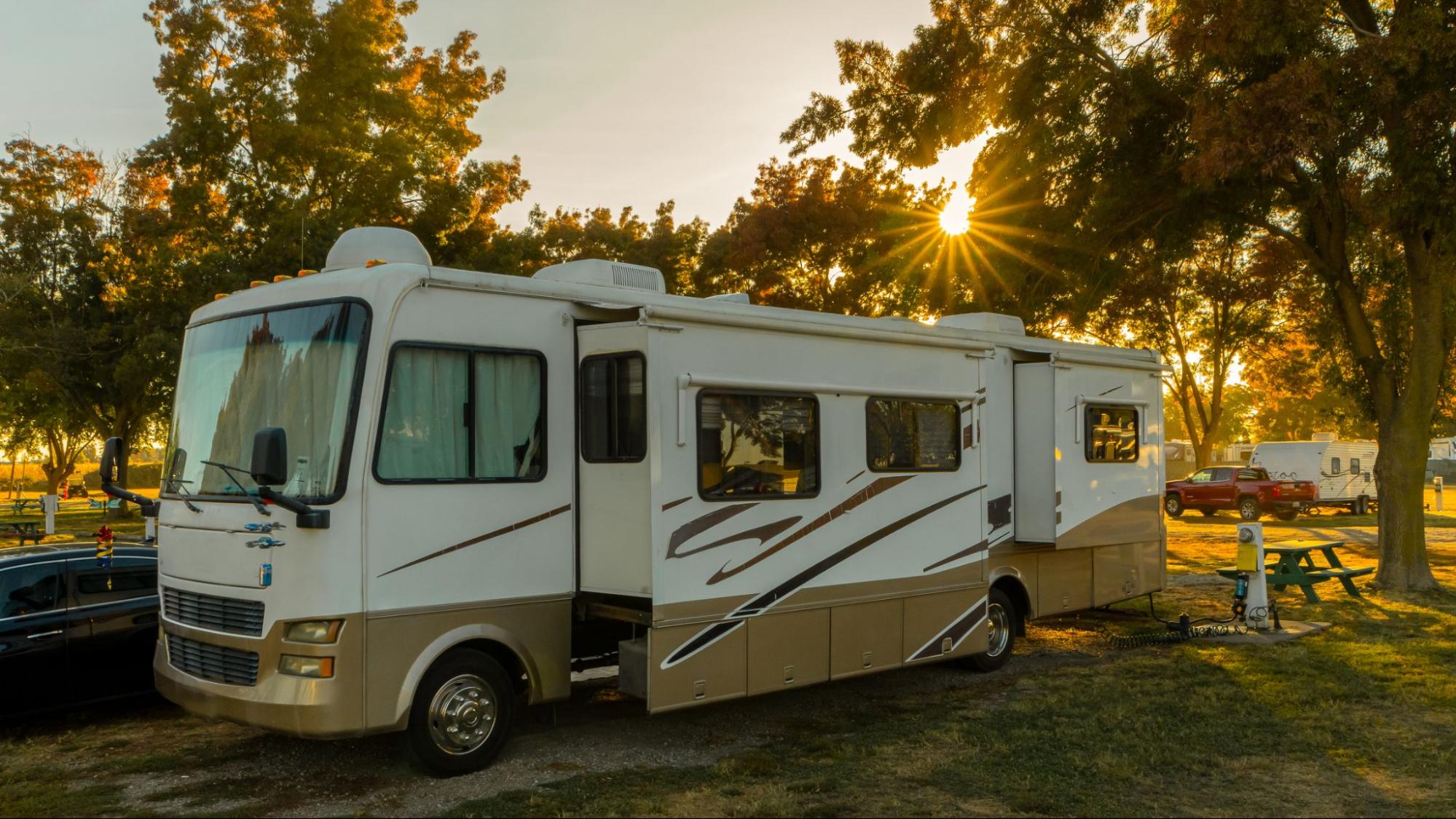
The Short Answer: A 30-amp RV has one 120-volt circuit and up to 3,600 watts of shore power. A 50-amp RV has two separate 120-volt, 50-amp hot legs and up to 12,000 watts total. If you have a smaller travel trailer with one AC unit, 30-amp may be enough. If your RV has two air conditioners or you want to run several high-draw appliances at once, you will usually need 50-amp service.
How your RV connects to power at a campground depends on its shore power cord, main panel, and factory electrical system. A 30-amp RV plug has three prongs, while a 50-amp RV plug has four. If the campground pedestal doesn’t match your plug, a dogbone adapter lets you connect, but it cannot create more available power than the outlet or your RV electrical system allows. If you camp without hookups, RV power inverters and solar equipment give you another way to run selected loads and recharge your battery bank.
The Difference Between 30 Amp and 50 Amp RV Service
Your RV’s amp service tells you how much AC electricity it can draw from a campground power pedestal before the breaker trips. It is the maximum your electrical system can use while plugged into shore power, not the amount your RV always consumes.
A 30-amp RV connection uses one 120V hot wire, one neutral wire, and one ground wire:
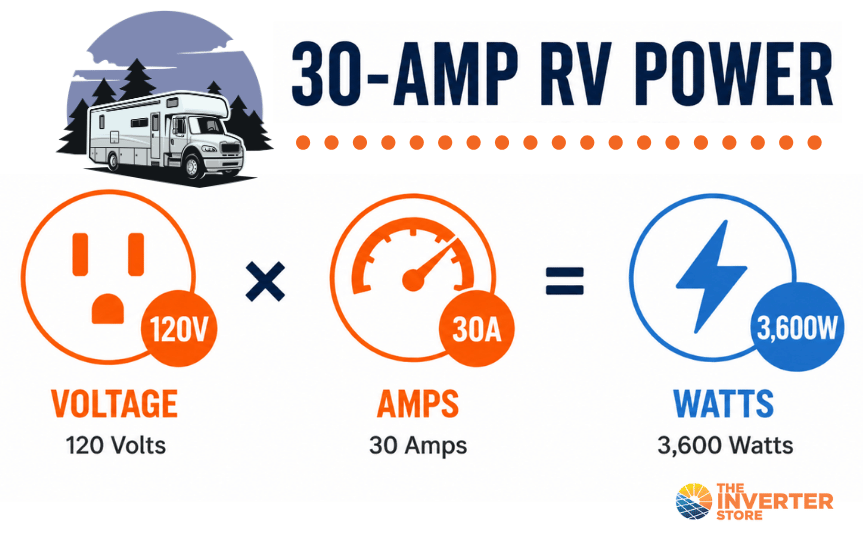
That 3,600 watts must cover everything running in the RV, including the air conditioner, microwave, water heater, coffee maker, hair dryer, refrigerator, converter, lights, and outlets. This service is common in smaller RVs, pop-up campers, and many travel trailers with one AC unit.
A 50-amp RV connection has two 120V hot legs, one neutral, and one ground. Each leg can supply up to 50 amps:
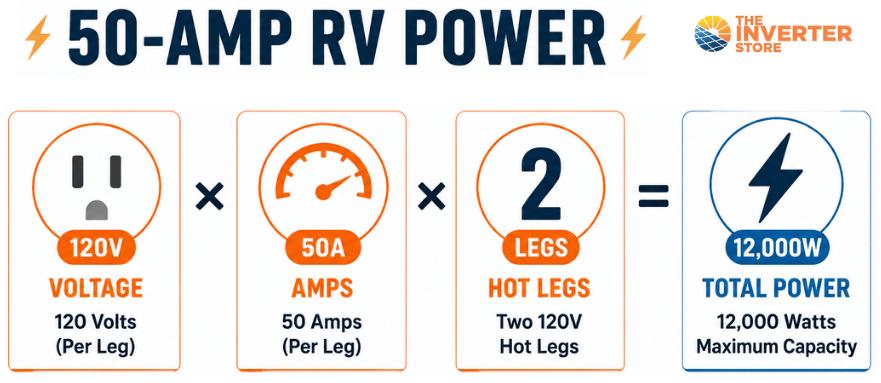
That is more than three times the power capacity of a 30-amp connection. It is common in larger travel trailers, fifth wheels, and motorhomes with two AC units or more residential-style appliances. A 50-amp RV does not constantly use 12,000 watts. It simply has more capacity to run equipment simultaneously.
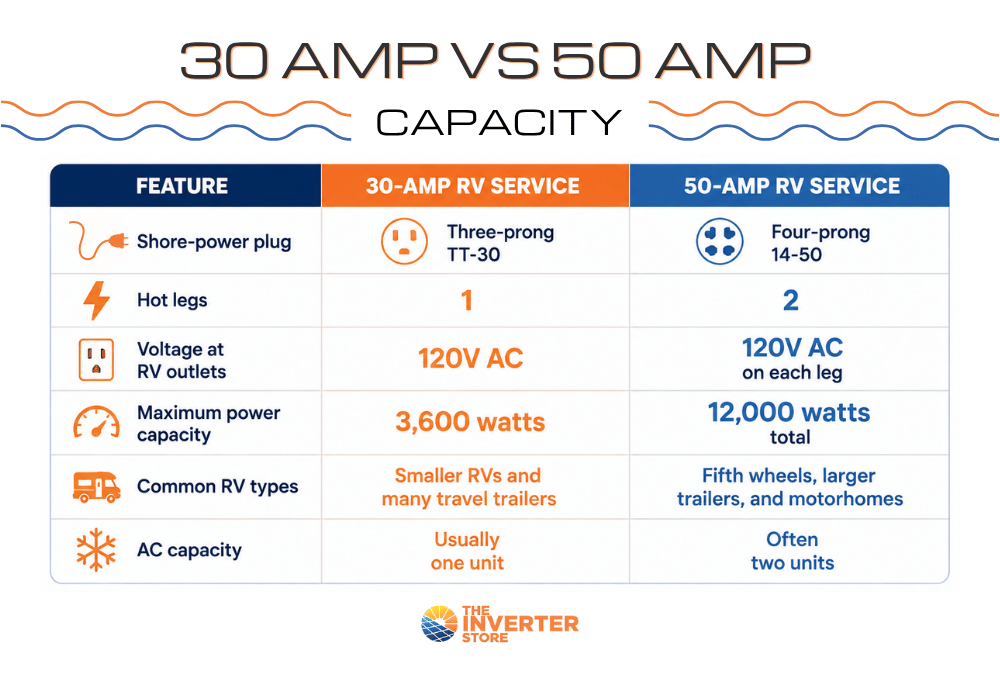
30 Amp vs. 50 Amp Capacity
What Can You Run on a 30-Amp RV Connection?
A 30-amp RV connection can run the basics, but you’ll need to manage high-draw appliances. Your refrigerator, converter, lights, TV, and phone chargers already use part of the 3,600 watts. Add an AC unit, microwave, electric water heater, hair dryer, coffee maker, or electric griddle, and the remaining power capacity goes fast.
- A standard 13,500 BTU RV air conditioner commonly uses about 10 to 15 amps, or roughly 1,300 running watts.
- An electric hair dryer can draw between 500 and 1,500 watts.
- A coffee maker may use 550 to 750 watts.
- A microwave, electric griddle, or electric water heater can each pull 1,000 watts or more, depending on the model.
Check the wattage or amp rating printed on your actual appliance before building a power-use routine, and use these typical RV appliance wattage ranges as a starting point for your calculations.
What Can You Run on a 50-Amp RV Connection?
A 50-amp RV connection gives you more room to use the RV without shutting one appliance down every time you turn another one on. Two AC units at roughly 1,300 watts each use about 2,600 watts together. A 50-amp service has enough capacity for those units plus typical everyday loads such as the refrigerator, converter, lights, electronics, coffee maker, and microwave.
Your RV’s main panel divides circuits between two hot legs. You can still trip a breaker if several high-draw appliances are connected to circuits on the same leg. Check the RV wiring diagram or owner’s manual if you need to know which appliances share circuits.
A Real Wattage Example
Let’s say your RV AC unit is running at 1,300 watts. The refrigerator and converter use another 350 watts combined, and you turn on a 750-watt coffee maker:
1,300W + 350W + 750W = 2,400W
That leaves about 1,200 watts before the 3,600-watt ceiling. Now turn on a 1,500-watt hair dryer:
2,400W + 1,500W = 3,900W
That is over the available capacity. Turn off the coffee maker or AC unit before using the hair dryer, then switch it back on when you are done.
If you regularly camp without shore power, the same load math helps you calculate the right pure sine wave inverter and LiFePO4 lithium battery capacity for your needs. Your inverter needs enough continuous wattage and surge capacity for the appliances you plan to run, while the battery bank determines how long you can run them.
RV Plugs and Adapters
How to Identify Your RV Shore Power Plug
Start with your shore power plug. A 30-amp RV cord has three prongs. A 50-amp RV cord has four. Your main panel should match: a 30-amp RV has one main breaker labeled 30 amps, while a 50-amp RV has a two-pole main breaker labeled 50 amps.
Using RV Adapters at a Campground
An RV adapter can connect your shorepower cord to a different outlet at the campground power pedestal. It matches the plug to the available connection, but it does not change your RV’s wiring, breaker panel, or available amp power.
For an RV battery system, use inverter and battery cables that are sized for the system voltage, inverter wattage, and cable length. Do not use a homemade adapter or change breakers to get more shore power.
Shore Power Safety
Use a heavy-duty inverter, battery, and solar cable that matches your shore-power setup. Keep it as short as you can, since longer or undersized cords can cause voltage drop and create problems for motor-driven equipment such as an AC unit.
Before you plug in, turn the breaker off at the power pedestal and inspect the outlet. Do not use a receptacle with burn marks, cracks, corrosion, or loose parts. After connecting your RV to shore power, check the plugs and cord connections. If it feels hot, smells like melting plastic, buzzes, or causes lights to dim when the AC starts, disconnect and report the pedestal to the RV park.
If the breaker trips, always turn off high-draw appliances before resetting it. If it trips again after you reduce the load, stop resetting it. The issue may be the cord, plug, outlet, RV wiring, or campground pedestal.
Find the Right RV Power Setup
Your RV’s wiring and main panel determine its shore-power capacity, but you decide how to manage the loads inside it. A 30-amp RV works well for everyday needs when you avoid running several high-draw appliances at once. A 50-amp RV gives larger rigs more room to run two AC units, kitchen appliances, and other daily loads together.
If you camp without hookups, start by adding up the loads you want to run. Then use our power calculator to estimate the inverter wattage and battery capacity your setup needs. Browse RV power inverters and solar equipment, pure sine wave inverters, and LiFePO4 lithium batteries to build a system that fits your travel trailer or motorhome.
Not sure what fits your RV? Contact The Inverter Store or call 888-417-8673 to talk to a real person. We can help you work through your power usage before you buy.
Frequently Asked Questions
Is 50-amp RV service 240 volts?
A 50-amp RV shore-power plug has two 120V hot legs, which measure 240V between them. Inside most RVs, however, appliances and outlets run on 120V circuits. The two hot legs split the RV’s circuits equally and provide up to 12,000 watts of total capacity.
Can I run an air conditioner on a 30-amp RV connection?
Yes. Many 30-amp travel trailers run one AC unit. You will need to manage your other power use while it is on. Turn off high-draw appliances such as an electric water heater, microwave, coffee maker, hair dryer, or electric griddle before starting another major load to avoid downtime or tripped breakers.
Can I plug a 30-amp RV into a 50-amp outlet?
Yes. Use a 50-to-30-amp RV adapter to connect your 30-amp shore-power cord to a 50-amp outlet at an RV park. The adapter matches the plug to the power pedestal, but your RV remains limited to 30 amps and 3,600 watts.
Can I plug a 50-amp RV into a 30-amp outlet?
Yes, with a 30-to-50-amp RV adapter. Your RV will still receive power, but the entire electrical system is limited to 30 amps and 3,600 watts. Run one high-draw appliance at a time to avoid tripping the pedestal breaker.
Why does my RV breaker keep tripping at the campground?
The likely cause is too much power usage at once. Turn off the AC unit, electric water heater, microwave, coffee maker, hair dryer, and other high-draw appliances before resetting the breaker. If it trips again with only a light load, inspect the shorepower cord and plug for heat or damage, then ask the RV park to inspect the power pedestal.

Leave A Comment